

The ![]() Digital Landscape: Architects vs. Engineers
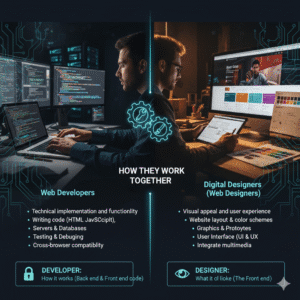
These two roles are, respectively, the Web developer vs Digital designer.
In the modern digital world, every successful website or app is a testament to two distinct, yet deeply intertwined, professions. Think of a web project as building a high-tech skyscraper: you need a visionary architect to plan the layout, look, and user flow, and a masterful engineer to construct the structural integrity, manage the plumbing, and ensure the building doesn’t collapse under pressure.
As technology advances with AI assistants becoming commonplace and user expectations soaring understanding where one role ends and the other begins is more crucial than ever, whether you’re hiring for a tech hub in San Francisco, seeking a remote specialist in London, or planning your next career move in the global digital economy.
Let’s break down the core differences, focusing on the specialized roles that define these professions in .
1. The Digital Designer: The Master of Experience (UX/UI)
The Digital Designer, often referred to as a Web Designer, is the creative and strategic mind focused on the human side of the digital product. Their goal is to ensure the website is engaging, aesthetically pleasing, and most importantly easy and intuitive to use.
Core ![]() Roles & Responsibilities:
| Sub-Role | Focus | Key Deliverables | |
| UX Designer (User Experience) | Strategy, research, and logic. They define how the site works. | User flows, sitemaps, usability testing, and wireframes. | Accessibility (WCAG standards) and user-research integration. |
| UI Designer (User Interface) | Visuals, interaction, and aesthetics. They define how the site looks and feels. | High-fidelity mockups, design systems (color, typography), and interactive prototypes. | Micro-interactions and leveraging dynamic, motion-focused design. |
| Visual/Graphic Designer | Creation of brand assets and imagery. | Logos, icons, custom illustrations, and photo optimization. | Cross-platform consistency across web, mobile, and social assets. |
Key Skills & Tools (Digital Designer):
- Software: Figma (dominant in
), Sketch, Adobe Creative Suite (Photoshop, Illustrator).
- Concepts: Information Architecture, Color Theory, Typography, User Journey Mapping, A/B Testing.
- The Edge: Mastery of responsive design principles and creating reusable Design Systems (like Google’s Material Design) for developer handoff.
2. The Web Developer: The Master of Functionality (Front-End/Back-End)
The Web Developer is the technical specialist who takes the designer’s visual blueprint and translates it into functional, performant code. They are responsible for the entire technical stack, from what you see to the servers and databases that run silently behind the scenes.
Core ![]() Roles & Responsibilities:
| Sub-Role | Focus | Key Deliverables | |
| Front-End Developer | Client-side coding (what the user sees and interacts with). | Converting design mockups into HTML, CSS, and JavaScript. | Optimizing Core Web Vitals (speed, stability) for Google’s search ranking. |
| Back-End Developer | Server-side logic, database, and application integration. | APIs, security protocols, database management (SQL/NoSQL), and server configuration. | Cloud-native development (AWS, Azure) and implementing robust security against cyber threats. |
| Full-Stack Developer | Managing both the front-end and back-end of an application. | End-to-end web app development, deployment, and maintenance. | Proficiency in a full stack (e.g., MERN, LAMP) and utilizing modern DevOps practices. |
Key Skills & Tools (Web Developer):
- Languages: HTML5, CSS3, JavaScript (essential). Back-end languages like Python, PHP, Ruby, or Node.js.
- Frameworks: React, Vue.js, Angular (for front-end); Django, Laravel, Express (for back-end).
- The Edge: Expertise in performance optimization, integrating AI services (e.g., generative content APIs), and advanced Technical SEO implementation (Schema Markup, sitemaps).
3. Web Developer vs. Digital Designer: A ![]() Comparison
| Feature | Digital Designer (The Architect) | Web Developer (The Engineer) |
| Primary Goal | Visual Appeal & Usability: How the site looks, feels, and guides the user. | Functionality & Performance: How the site works, loads, and handles data. |
| Focus | User Experience (UX) and User Interface (UI). | Code Logic, Data Structure, and System Architecture. |
| Core Output | Wireframes, Prototypes, Design Systems, Visual Assets. | Functional Code, Databases, APIs, and Optimized Build Files. |
| “Success” Metric | Conversion Rate, Time on Page, User Satisfaction Scores. | Page Load Speed, Uptime, Security, Clean Code Quality. |
| The Intersection | Front-End Development: Highly collaborative here, as designers deliver assets that Front-End Developers directly implement. |
The Critical ![]() Overlap: Technical Design
The most significant trend of is the need for designers to be technical and developers to be design-aware.
- Designers are expected to deliver a Design System (a library of reusable components) that maps perfectly to the developer’s component library, minimizing “translation” errors.
- Developers are expected to prioritize UX/UI principles, ensuring their code is not just functional but also adheres to speed, responsiveness, and accessibility standards set by the design team.
Choosing Your Path: The Future is Full-Stack Collaboration
Whether you’re starting a career or seeking a specialized professional for your business, the choice between a Web Developer and a Digital Designer boils down to your core need:
- Need a new brand identity, improved user flow, or stunning visuals?
Hire a Digital Designer.
- Need custom functionality, database integration, or a lightning-fast, secure app?
Hire a Web Developer.
- Need to build a robust, scalable digital product from concept to launch?
Hire a collaborative team of both.
In , no matter the specific role, success belongs to those who embrace continuous learning, value cross-functional communication, and leverage the newest AI tools not to replace their work, but to elevate it.